

(^^ a note, yes I had to bribe Luna 🐾 with treats to get this photo… worth it!!!)
Winning a board game because you made a brilliant move feels great, but winning because you blocked your spouse from taking the exact action space they needed?… That’s even better. 😈 🤣
Worker placement games have become one of our favorite board game categories because every decision comes with tradeoffs. There are never enough resources, actions, or turns for all you want to do. So you spend the entire game balancing your own strategy against the limitations while keeping an eye on everyone else at the table. This can be torturous for certain people prone to what board gamers call “analysis paralysis” or AP. But for most people, it’s a delightful puzzle.
Before I met David, I didn’t know the phrase “worker placement game” existed. I grew up in a house where a deck of cards was reached for far more than a board game. And even then, I thought Scattergories was the upper echelon. (It still is.) But *oohwhee,* this board game education has been one of the best ‘life upgrades’ that my marriage has brought me.
After a decade of game nights, here are some of the worker placement games we regularly return to and are happy to play again and again.
Our favorite worker placement board games
Viticulture

$52.00
Stonemaier Games: Viticulture Essential Edition
- Why we love it: The seasonal worker system creates difficult decisions between the spring and fall
- Best for: Couples and intermediate gamers
- Play time: About 60-90 minute
Low-Key Coffee Snobs is funded by affiliate commissions which we (often) make when you buy products we link.
If you had asked me to describe a board game about planting grapes, harvesting fields, aging wine, and filling custom orders before I played Viticulture, I would have assumed it was a snooze-fest. I would have been wrong!
I still long for the ability to “speak wine,” but until then, I’m happy to continue playing Viticulture (while drinking wine) with friends. In this game, you manage a vineyard while competing for limited action spaces through the changing seasons. Planting grapes in the spring might mean giving up the chance to harvest them and send them to market in the fall. Planting too many grapes, or going for short-term rewards are going to punish you. And you’ll often find yourself just short of the step you need to fulfill those valuable wine orders. (Not to mention those sweet residuals!) The game starts with making red and white wines, but you eventually grow into making rosés and bubbles, too. 🥂

The seasonal worker system is one of my favorite mechanics. Instead of using all of your workers at once, you have to decide how many to commit to the spring and fall seasons. In winter and summer, you draw cards which keep the seasonal turns more exciting.
We like this worker placement game for its nice balance of strategy and accessibility. It’s deep enough for experienced gamers (David) but approachable enough that we don’t have to spend 30 minutes rereading the rulebook every time we pull it off the shelf.
Agricola

$77.03
Agricola (Revised Edition)
- Best for: Experienced strategy gamers.
- Play time: About 90-120 minutes.
- Why we love it: Every round forces difficult trade-offs.
Low-Key Coffee Snobs is funded by affiliate commissions which we (often) make when you buy products we link.
Agricola is one of the most famously “punishing” worker placement games people think of. It’s a Uwe Rosenberg classic for a reason. It’s a great encapsulation of some of the best features of worker placement games. It’s also the game David credits/blames for his learning that certain games are too complicated to play with certain friends & family.
In Agricola, you start with a small farmhouse and a family that needs to eat every single round. Your job is to gather resources, expand your house, plant crops, raise animals, and keep everyone fed. That may sound familiar, but it’s also kind of hard here. Food shortages are constant, and resources are taken (or stolen, pick your word) before you can claim them. And every round introduces new action spaces that can totally change your priorities and strategy.

Our copy is the original Z-Man Games edition that we’ve owned for years, and it’s still one of our favorite games in our collection. If you’re buying Agricola today, though, be aware that the game subtly changed. The original edition combined both family and advanced rules in a single box and supported up to five players. The current publisher, Lookout Games, now prints two separate versions: the more-approachable Family Edition and the Revised Edition, which adds the strategic Occupation and Minor Improvement cards. (David’s note: people inexperienced in modern/complex games may find even the Family Edition overwhelming. I like the bonuses of the Revised Edition, but only play it with “gamer friends.”)
We also own All Creatures Big and Small, the fantastic two-player spin-off that focuses almost entirely on animal husbandry.
Le Havre

$82.34
Le Havre
- Why we love it: Resources evolve into satisfying production chains.
- Best for: Players who enjoy economic strategy
- Play time: About 120-150 minutes
Low-Key Coffee Snobs is funded by affiliate commissions which we (often) make when you buy products we link.
Now our list of worker placement games takes us to a French harbor, with another game from Uwe Rosenberg, widely regarded as the worker-placement GOAT among board game nerds. While Agricola is about surviving on a small family farm, Le Havre is about building an economic empire one resource at a time.
You collect wood, clay, grain, cattle, fish, iron, coal, and a whole pile of other resources while expanding your shipping company and constructing new buildings. The unique part is that almost everything can be transformed into something else: Fish become smoked fish, grain becomes bread, and iron becomes steel.

Your turns feel like a puzzle as you try to determine whether you should collect more resources, process the ones you already have, or invest in buildings that will make future turns more efficient.
Le Havre is heavier than Viticulture and less punishing than Agricola. It’s a nice middle ground for players who enjoy optimization and long-term planning, or turning small advantages into enormous engines.
A sneaky tip: You can even play this board game on the go with the Le Havre board game app.

It’ll cost you a couple of bucks to download, but setup is a breeze (ha). It’s one of our favorite ways to play high-strategy games on the go (without packing all the giant boxes).
Targi

$24.13
Targi
- Why we love it: A fun geometric puzzle which is made more elegant by supporting only two
- Best for: Couples and other two-player households
- Play time: About 60 minutes
Low-Key Coffee Snobs is funded by affiliate commissions which we (often) make when you buy products we link.
Most worker placement games are designed for three or four players, but Targi throws that idea out the window. The entire game is built specifically for two people, and it works brilliantly.
Instead of placing workers directly onto action spaces, players place tribe members along the edges of the board. The intersections between those placements determine which actions you do.
It’s an incredibly clever system. You trade dates, salt, pepper, and gold while building your tableau. If you mostly play board games as a couple, this is the worker placement game I’d recommend first.

Five Tribes

$71.99
Five Tribes
- Why we love it: The mancala-style movement lets you pick up a tile's meeples and sow them one by one across the board, so every turn is a puzzle.
- Best for: Players who like tactical, puzzly games with a lot of ways to score.
- Play time: About 60–80 minutes
Low-Key Coffee Snobs is funded by affiliate commissions which we (often) make when you buy products we link.
Days of Wonder has a well-earned reputation for putting out great games. And Five Tribes was another winner for us. It’s a bit different than what most picture when we talk about “worker placement,” but you’ll see that become a pattern in the middle of the list where I’ve let myself be a bit more expansive ;p
In Five Tribes you compete to get the most points. But you do it in an interesting mancala-like system. For the unfamiliar, Mancala is a classic pick-and-drop game, literally hundreds (or thousands, opinions differ) of years old. In Five Tribes it means that you gather a group of “workers” from a tile, and then place them in a path away from that tile, leaving one at each intervening tile. Then on the last tile you trigger an action based on how many other “workers” of that color were there. It sounds more complicated in this paragraph than it is when you see it!
There are also djinn (genies in more typical American spelling) and a few other interesting twists to make it both more rewarding and strategically deeper. And there’s an important set-collection system for the goods you get at the market. I find it both more approachable and more fun than many other worker-placement games.
Orléans

$49.95
Orleans
- Why we love it: The bag-building system creates a completely different experience.
- Best for: Players who enjoy engine-building and economic games.
- Play time: About 90 minutes.
Low-Key Coffee Snobs is funded by affiliate commissions which we (often) make when you buy products we link.
Before the board game purists come after me, I know. Orléans isn’t a *pure* worker placement game. It’s technically a bag-building game with worker placement elements, but I’m including it anyway.
Because more 👏 people 👏 should 👏 play 👏 Orléans. 👏
Instead of managing a fixed pool of workers, you gradually fill a cloth bag with farmers, merchants, monks, knights, scholars, and craftsmen. At the beginning of each round, you pull those workers from the bag and assign them to different actions.
Your strategy isn’t limited to deciding where to place workers. You’re also deciding which workers deserve a permanent place in your bag. The result is one of the most satisfying economic games I’ve ever played.
If you’ve already played the usual worker placement classics and want something that feels fresh, Orléans should be at the top of your list.
Istanbul

$56.29
Istanbul: Big Box Edition
- Best for: Players who enjoy optimization puzzles.
- Play time: About 40-60 minutes.
- Why we love it: Unique movement-based worker system.
Low-Key Coffee Snobs is funded by affiliate commissions which we (often) make when you buy products we link.
Oops I did it again. Technically, Istanbul isn’t a traditional worker placement game. But I also don’t care. It’s one of our favorite games, and I think anyone who enjoys worker placement should absolutely give it a shot.
Instead of placing workers on a shared board and leaving them there for the rest of the round, you’re moving a merchant and a stack of assistants through a bustling bazaar. Every location offers a different action.

The catch is that you have to carefully manage your assistants as you move from location to location. Leave them behind at the wrong time, and you’ll eventually discover that your merchant has wandered halfway across Istanbul with nobody left to help.
That movement puzzle is what makes this twist on a worker placement game so much fun. If you already love games like Viticulture, Agricola, and Targi, Istanbul feels like a natural next step.
Everdell

$75.00
Everdell
- Best for: Players who enjoy beautiful artwork and engine-building.
- Play time: About 40–80 minutes.
- Why we love it: It combines worker placement with tableau building.
Low-Key Coffee Snobs is funded by affiliate commissions which we (often) make when you buy products we link.
I know we’re supposed to be discussing gameplay here, but let’s be honest. The giant cardboard tree gets everyone’s attention first.
Everdell combines worker placement with tableau building in a woodland world filled with critters, farms, castles, and tiny construction projects. And yes, it’s every bit as charming as it sounds.

Resources are always tight, card combinations can be surprisingly powerful, and there are multiple paths to victory. One game might revolve around collecting specific cards, while another might focus on expanding your city as quickly as possible.
It’s one of the few strategy games we’ve introduced to non-gamers (even my mom) that immediately made them ask, “Can we play again?”
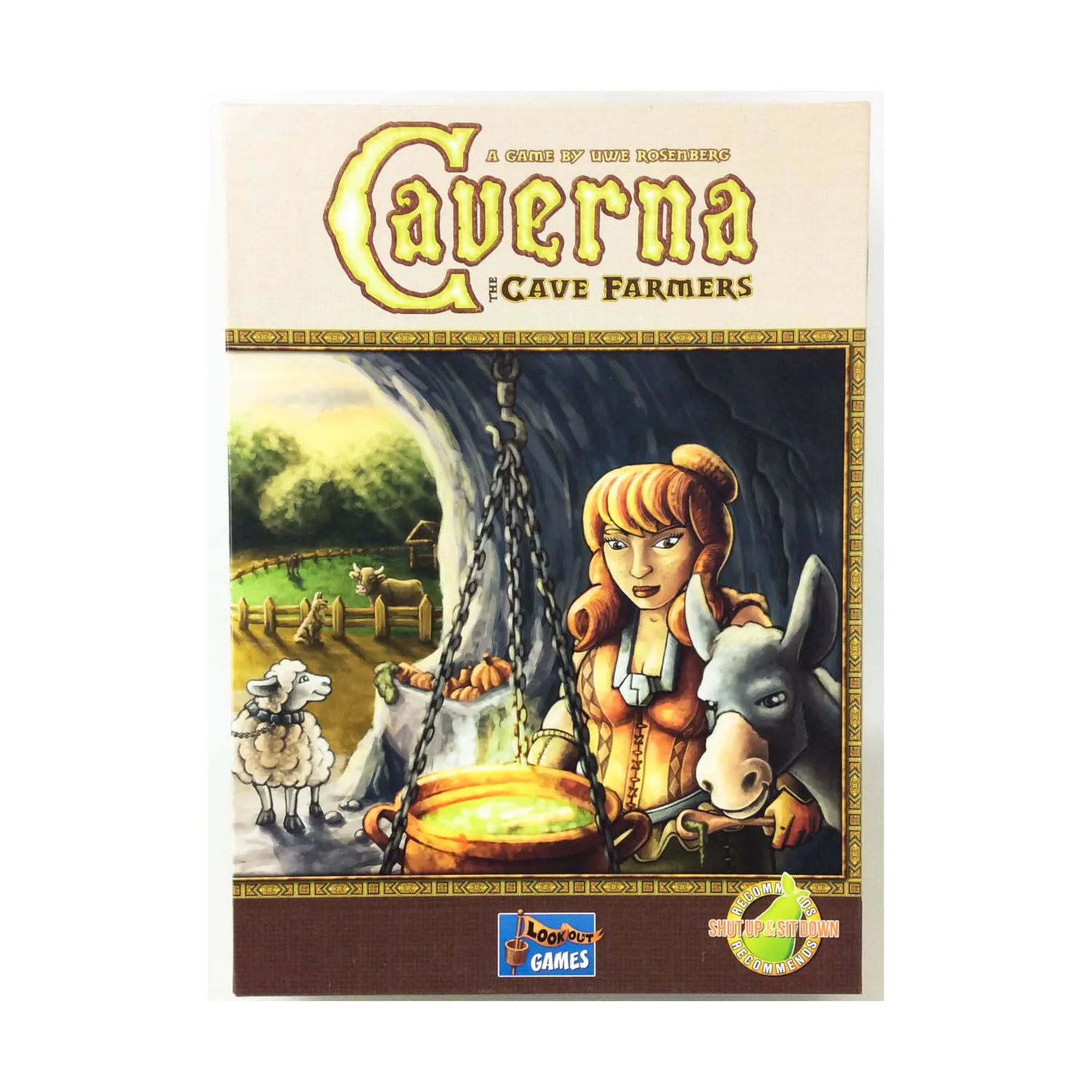
Caverna
$175
Caverna – The Cave Farmers
- Best for: Players who enjoy open-ended strategy.
- Play time: About 90–150 minutes.
- Why we love it: It offers more flexibility than Agricola.
Low-Key Coffee Snobs is funded by affiliate commissions which we (often) make when you buy products we link.
From the same creator as Agricola and Le Havre, Caverna takes many of the ideas that made Agricola famous and loosens the screws a bit. It’s a little less “punishing” than Agricola, which people often complain about.
You’re still farming and gathering resources, only this time, you’re a dwarf.

Instead of desperately trying to keep your family fed, you’re digging rooms into a mountainside, collecting animals, mining for ore, furnishing caves, and building an entire underground kingdom.
These days this game can be hard to get your hands on, but if you do, you’ll be rewarded.
Other recommended worker placement board games

We haven’t personally tested these, but they’re on our list of top worker placement board games to try. We’re hoping to take a spin this fall at GrandCon, an awesome board game weekend held annually in our former residence, Grand Rapids, MI. (Although, David and his board game geek buds were just discussing a trip to SPIEL Essen next year!)
- Champions of Midgard: Place workers to hire warriors (who become dice), gather food, and grab boats, then send those warriors out to fight trolls and monsters. Worker placement as the setup for combat.
- Dune: Imperium: Your cards decide which spaces your agents can visit, so deckbuilding and worker placement feed each other and every hand turns into a small puzzle.
- Lost Ruins of Arnak: The board gets bigger as you play, because sending archaeologists into the jungle uncovers new dig sites (and the guardians that come with them).
- Raiders of the North Sea: You only have one worker, placing it and then picking up a different one, so the workers keep moving around the board and you’re always playing off what your opponents just did.
- Stone Age: This is the classic gateway game: place workers to gather resources, grow your tribe, and feed everyone, with a dice roll that keeps each placement from being a sure thing.
- Tzolk’in: The Mayan Calendar: Workers ride rotating gears and their actions get better the longer they stay, so the main decision is when to place them and when to pull them off.
- Underwater Cities: Each placement also plays a card, and matching the card’s color to the action space gets you both effects, so you’re always trying to line up the right card with the right spot.
- A Feast for Odin: Stronger actions take more Vikings, so you’re always choosing between a few big moves and several small ones, with more than 60 action spaces to pick from.
Stock up on worker placement games

I’m so grateful David introduced me to an entire world of Eurogames that somehow turned farming, winemaking, and trading into brutally competitive experiences.
Whether you prefer the relentless pressure of Agricola, the cozy competition of Viticulture, or the clever two-player design of Targi, there’s a worker placement game out there with your name on it.
What worker placement games did we miss? Let us know in the comments!


